
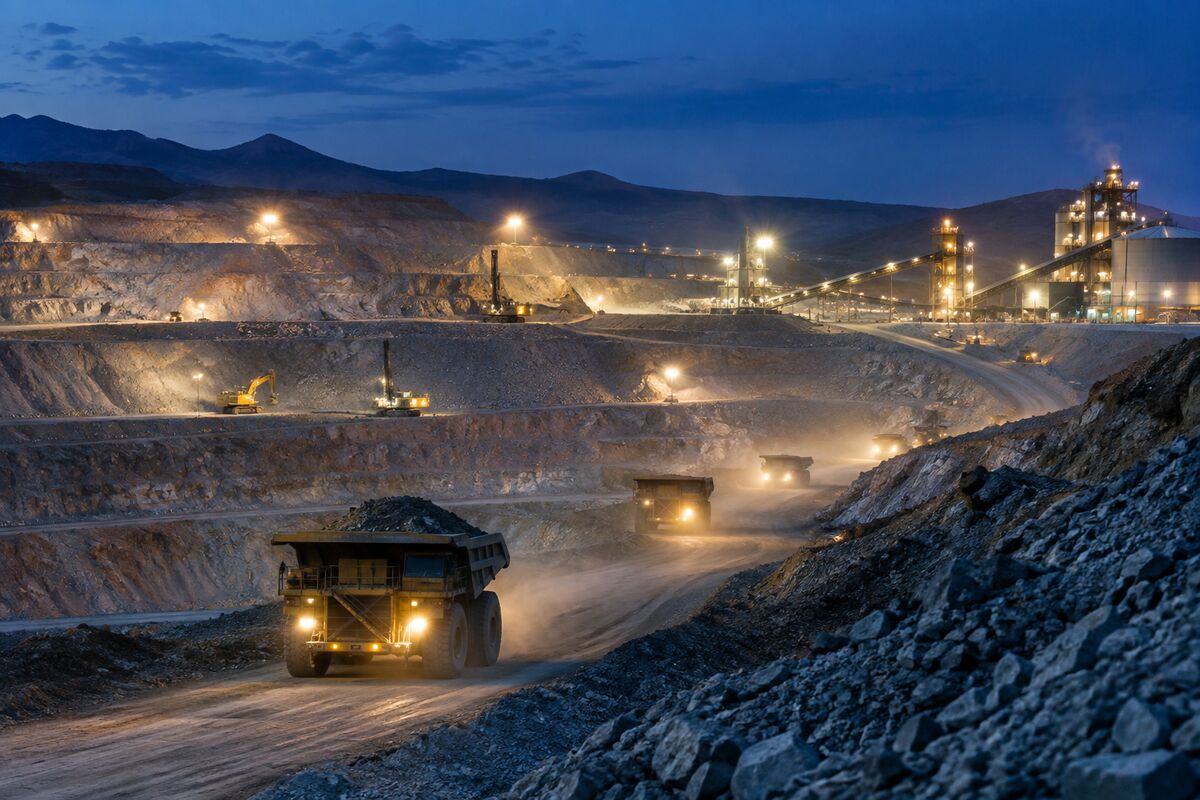
The mining market’s leadership has changed—and the reversal has been expensive. The top 50 mining companies collectively lost $264 billion as the gold trade unwound, turning what had looked like a powerful hard-asset narrative into a sharp reminder that commodity exposure does not move as one trade.
For investors in US- and Canadian-listed mining equities, the message is clear: a sector label is not a hedge. Gold producers, TSX and TSX Venture juniors, and lithium-exposed companies may all sit within the broader mining universe, but their valuations are increasingly being driven by different commodity cycles, expectations and measures of momentum.
The latest figures, reported by Mining.com, describe a broad valuation reversal rather than a uniform collapse across every raw material. That distinction matters. Copper and iron ore ended the month almost exactly where they began, highlighting the uneven performance beneath the headline decline.
Gold’s reversal changes the sector conversation
The $264 billion loss among the top 50 miners shows how quickly market leadership can shift when the gold trade unwinds. The figure applies to the group collectively; it is not price data for any individual company, nor does it establish that every listed producer or junior moved in the same direction.
Still, the sector-level change carries clear implications for US and Canadian investors. Listed gold producers may remain central to mining portfolios, but the latest reversal suggests that gold exposure can bring substantial valuation sensitivity when market enthusiasm fades. That is especially relevant for smaller TSX and TSX Venture juniors, where investor attention can be closely tied to commodity narratives and perceived exploration or development momentum.
The historical lesson is familiar: mining leadership rarely stays in one corner of the periodic table forever. Gold can command attention, lithium can become the market’s preferred growth story, and industrial metals can move on a different timetable altogether. Investors using mining stocks as inflation or hard-asset hedges may therefore find that the protection they expect depends heavily on which commodity—and which stage of the mining cycle—they actually own.
Lithium loses its place at the top
Lithium stocks have now fallen out of the top rankings after appearing several months ago to be reaching “escape velocity.” That change is significant for critical-minerals portfolios because lithium remains closely associated with battery-metal exposure and the electric-vehicle supply chain.
The point is not that the long-term battery-materials theme has disappeared. The data provided do not establish that. Rather, the ranking change indicates that market leadership and investor enthusiasm have moved elsewhere. A portfolio built around critical minerals may therefore face a different risk profile when lithium no longer occupies the same position in the market hierarchy.
For US and Canadian-listed companies with lithium exposure, the implication is equally important: thematic relevance does not guarantee sustained market leadership. The sector may remain strategically important, while its equities lose momentum relative to other mining groups. That gap between industrial importance and market performance is one of the defining complications of critical-minerals investing.
Uneven commodities, selective exposure
Copper and iron ore finishing the month almost exactly where they began reinforces the central point. The mining sector’s aggregate loss was driven by an uneven shift in leadership, not by an identical move across all major commodities.
That leaves investors with a more complicated map of the market. Gold’s unwind has weakened the broad hard-asset narrative; lithium’s exit from the top rankings challenges the assumption that battery metals will remain the dominant growth trade; and copper and iron ore have shown relative stability over the measured month.
The prudent analytical conclusion is not that one commodity has permanently replaced another. It is that mining equities should be evaluated by their specific commodity exposure and market position, rather than treated as a single inflation hedge or critical-minerals basket. The $264 billion reversal is a warning about concentration in popular narratives—and a reminder that leadership in mining can change before the underlying strategic story does.
Bull/Bear Verdict
Bull Case: The uneven performance—particularly copper and iron ore ending the month almost exactly where they began—could suggest that the $264 billion sector-level decline reflects a shift in leadership rather than a uniform breakdown across mining.
Bear Case: The $264 billion loss and lithium stocks’ exit from the top rankings may indicate that investors using mining equities as broad hard-asset or critical-minerals exposure face sharper valuation reversals than the sector label implies.