
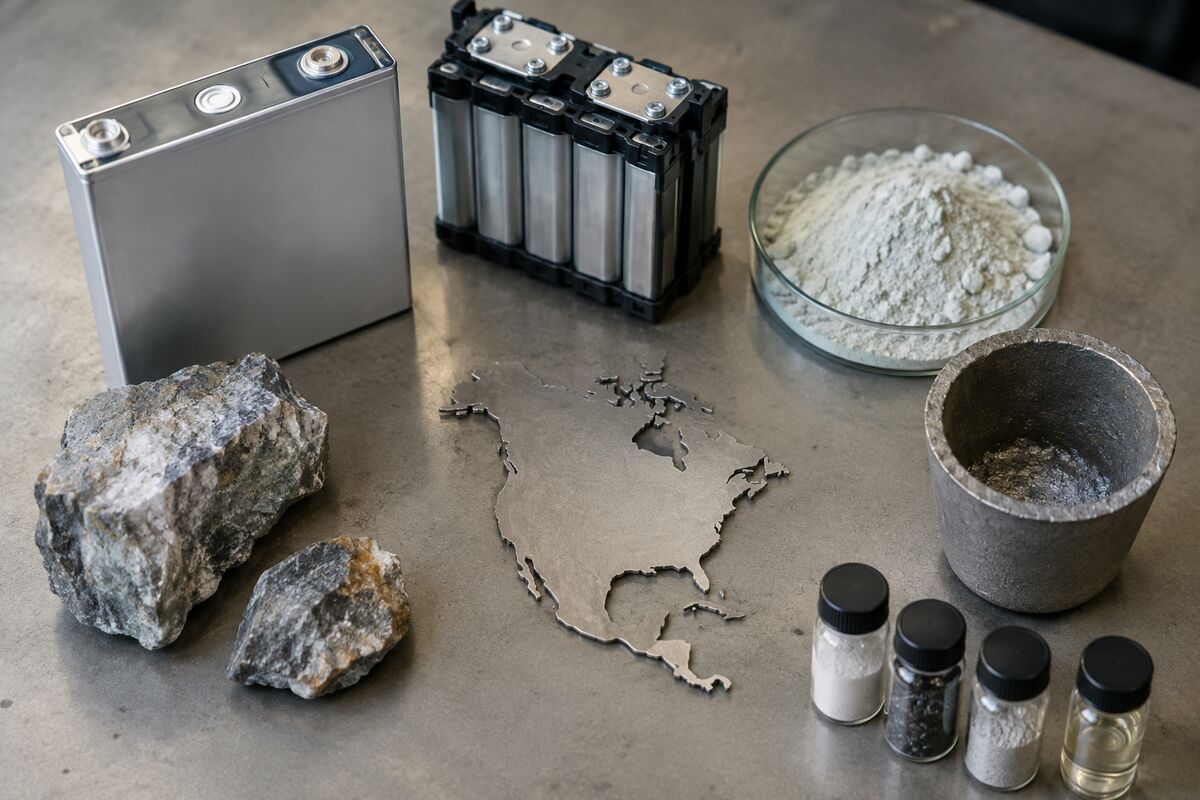
North America’s battery-supply-chain debate is moving beyond the question of where minerals are found. The more consequential question may be where those materials are processed, converted and assembled into the components needed for electric vehicles. First Phosphate used an AI & Technology Virtual Investor Conference presentation to place that question at the center of its LFP strategy.
The company’s message was clear: lithium iron phosphate, or LFP, batteries need a supply chain rooted closer to the markets they are intended to serve. By highlighting partners in Tennessee, Nevada and Montreal, First Phosphate framed onshoring as a network-building exercise—one involving miners, processors, industrial suppliers and public-sector support across the United States and Canada.
That framing matters for investors watching the critical-minerals sector. A domestic battery ecosystem is not created by a single mine or one processing plant. It depends on multiple links working together, and First Phosphate’s presentation named several companies it sees as part of that broader chain.
A regional map for LFP materials
Among the cited partners was GKN Hoeganaes in Tennessee. The company also pointed to Century Lithium in Nevada and Nouveau Monde Graphite in Montreal. Altilium, also in Nevada, was mentioned as another company in the presentation, although First Phosphate’s primary geographic emphasis remained the development of U.S. and Canadian supply-chain capacity.
The locations are significant in the context of North American industrial policy. Tennessee and Nevada represent U.S. manufacturing and mineral-processing links, while Montreal adds a Canadian connection to the materials network. Taken together, the names suggest a supply-chain thesis that is regional rather than isolated: raw materials and battery inputs could move through a set of North American relationships instead of relying as heavily on distant processing infrastructure.
That does not mean the presentation established a completed supply chain. It does, however, illustrate the kind of commercial alignment that junior mining and battery-materials companies may need to demonstrate as the market focuses more closely on downstream development. For early-stage businesses, being associated with a wider industrial ecosystem may help explain where their proposed role fits—even when the companies operate at different points in the value chain.
Government support enters the investment case
Management also discussed government and export-credit support for domestic critical-minerals processing. That point is central to the onshoring argument. Processing capacity can require substantial coordination between private companies and public institutions, particularly when governments view minerals and battery materials through the lens of energy security, manufacturing resilience and strategic competition.
For investors, the policy backdrop may be as important as the geology. Government backing could help direct attention toward companies positioned along the LFP value chain, while export-credit support may strengthen the case for processing infrastructure aimed at domestic or allied markets. But policy support is not the same as a completed project, and the presentation’s comments should be read as part of a broader strategic narrative rather than as evidence of production, financing or commercial completion.
“Onshoring” is ultimately a test of coordination: the mineral source, the processor, the industrial partner and the end market must connect.
What it means for battery-materials investors
First Phosphate’s presentation may be most relevant to investors assessing the flow of capital into companies that sit between mining and manufacturing. The named partners offer a picture of how LFP development could involve phosphate, lithium, graphite and specialized industrial inputs across several jurisdictions.
That picture also highlights the challenges. A North American supply chain must be more than a collection of promising names; it must demonstrate practical links between resource development, processing and battery demand. The companies cited by First Phosphate occupy different positions in that story, so their relevance may depend on how successfully the wider network develops.
For junior mining companies, the takeaway is potentially important. The investment conversation is expanding from “How much material is in the ground?” to “Who can process it, where can it be processed, and which partners can help move it toward a battery?” First Phosphate’s focus on U.S. and Canadian collaboration places those questions squarely in view.
The presentation therefore offers a useful snapshot of the North American critical-minerals race. LFP onshoring remains a supply-chain ambition, but the company’s cited partners and emphasis on government and export-credit support show how that ambition is being presented to the market. The next test for investors will be whether these strategic relationships translate into tangible domestic processing capacity and a more secure battery-materials ecosystem.
Read the company’s conference-related announcement and presentation coverage at Investing.com.
Bull/Bear Verdict
Bull Case: First Phosphate’s focus on LFP onshoring, partners including GKN Hoeganaes in Tennessee, Century Lithium in Nevada and Nouveau Monde Graphite in Montreal, plus cited government and export-credit support, may strengthen the case for a North American battery-materials network.
Bear Case: The presentation identifies strategic partners and policy support, but it does not establish completed processing capacity, production targets or financing; the investment thesis could therefore remain dependent on future execution across the supply chain.